
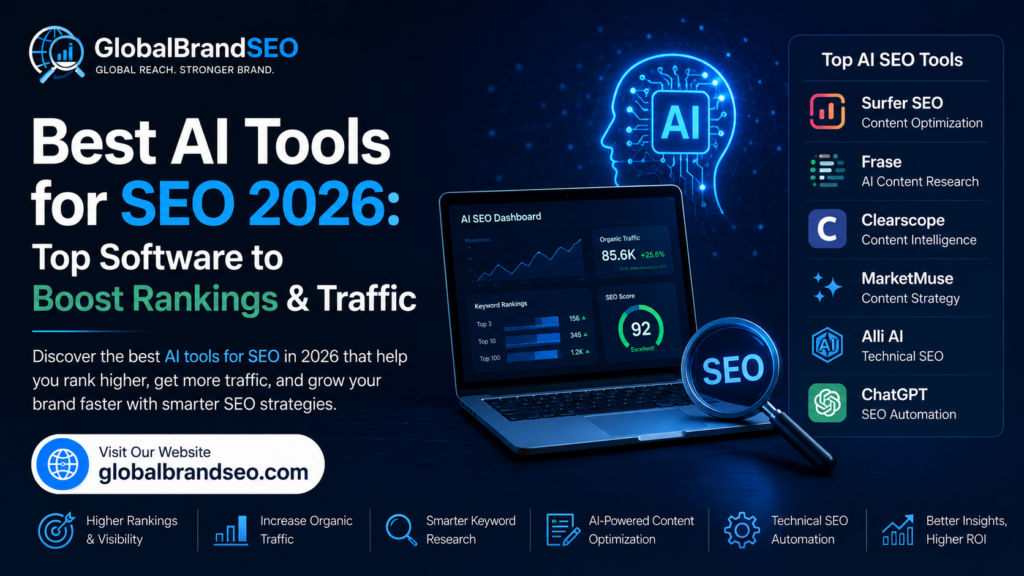

Search engine optimization (SEO) has become one of the most competitive areas of digital marketing in 2026, and leveraging artificial intelligence (AI) is now a key differentiator for brands looking to improve their search visibility. As businesses compete for clicks, rankings, and user engagement, AI-powered SEO tools have emerged as essential instruments for data-driven strategies. From automating content optimization to performing in-depth keyword research, AI tools can significantly reduce workload while delivering actionable insights. In this comprehensive guide, we explore the best AI tools for SEO 2026, highlighting their features, benefits, and how they can help you boost rankings, increase organic traffic, and maximize your marketing ROI.
Understanding AI in SEO: The 2026 Landscape
Artificial intelligence has reshaped SEO in the past few years, transitioning it from a largely manual process to a highly automated and intelligent discipline. In 2026, AI tools not only analyze vast datasets but also predict trends, optimize content for search intent, and even create adaptive strategies based on competitive analysis. Traditional SEO relied on keyword stuffing, backlink building, and manual audits, but modern AI tools use machine learning, natural language processing (NLP), and predictive analytics to provide real-time, actionable insights.
By integrating AI, marketers can better understand user intent, analyze competitor strategies, identify gaps, and optimize both on-page and off-page SEO. These advancements mean that businesses leveraging AI tools are more likely to maintain consistent rankings while reducing human error and time-intensive tasks. Whether you are a small business or an enterprise-level organization, AI-powered SEO software has become a non-negotiable investment for 2026.
Why Use AI Tools for SEO in 2026?
The competitive nature of SEO today requires more than basic analytics. Here’s why AI tools are essential for SEO professionals in 2026:
- Data-Driven Decisions: AI tools can process massive amounts of search data to identify trends, helping marketers make informed decisions about keywords, backlinks, and content structure.
- Content Optimization: AI algorithms analyze content performance, readability, and search intent to suggest improvements that increase visibility and engagement.
- Automation of Repetitive Tasks: Many AI tools can handle technical audits, meta tag optimization, and even link building, allowing marketers to focus on strategy rather than repetitive tasks.
- Predictive Insights: Using machine learning, AI tools can forecast search trends, helping businesses optimize for future traffic before competitors.
- Enhanced User Experience: AI tools analyze user behavior, dwell time, and click-through rates to improve overall UX, a critical factor for SEO success.
By integrating AI, businesses can stay ahead of the curve and gain a strategic advantage over competitors relying solely on traditional SEO methods.
Top AI Tools for Keyword Research in 2026
Keyword research remains the foundation of SEO, and AI tools have revolutionized the process. The best AI tools for keyword research can identify high-potential keywords, analyze search volume trends, and even suggest long-tail phrases aligned with user intent.
- SEMRush AI Keyword Tool: Uses AI to predict keyword difficulty, suggest alternative keywords, and generate content ideas based on trending search queries.
- Ahrefs’ AI Keyword Explorer: Combines historical search data and AI algorithms to suggest relevant keywords with actionable metrics.
- SurferSEO: Leverages NLP to analyze top-ranking pages and recommend semantic keywords that improve content relevance.
By using these AI-powered tools, marketers can uncover hidden opportunities, identify high-value keywords, and structure content to target queries that drive organic traffic.
AI Tools for Content Creation and Optimization
Creating high-quality, optimized content is time-consuming, but AI tools have simplified the process. Modern AI content tools not only generate text but also ensure it aligns with SEO best practices.
- Jasper AI: Generates engaging, optimized content for blog posts, landing pages, and social media, using contextual analysis to target search intent.
- Copy.ai: Produces long-form and short-form content, providing suggestions to improve keyword integration, readability, and SEO friendliness.
- Frase: An AI content optimization platform that analyzes top-ranking pages, recommends topic coverage, and helps improve on-page SEO metrics.
Using these tools, marketers can create content that satisfies search engines and users alike, improving rankings while saving significant time in the writing process.
AI Tools for Technical SEO and Site Audits
Technical SEO is crucial for ensuring that websites are crawlable, indexable, and optimized for performance. AI tools make these processes faster, more accurate, and predictive.
- Screaming Frog AI Integration: Scans websites for errors, broken links, duplicate content, and technical issues while using AI to prioritize fixes based on impact.
- DeepCrawl AI: Offers predictive technical insights and suggests optimizations for large-scale websites with complex structures.
- Sitebulb AI: Generates visualized reports, AI-powered recommendations, and actionable insights for improving website architecture and performance.
These tools allow SEO professionals to maintain site health, enhance crawl efficiency, and boost search engine rankings without manually combing through hundreds of pages.
AI Tools for Backlink Analysis and Link Building
Backlinks remain a cornerstone of SEO, and AI tools have transformed how professionals approach link building.
- Majestic AI: Uses AI to analyze backlink quality, detect spammy links, and identify opportunities for authoritative link acquisition.
- LinkGraph AI: Suggests high-value link prospects and predicts the potential impact of link-building campaigns on search rankings.
- Monitor Backlinks: Combines AI with historical data to track link growth, lost backlinks, and competitor link strategies.
With AI, marketers can make smarter link-building decisions, avoiding wasted efforts and focusing on high-ROI strategies.
AI Tools for Competitor Analysis
Understanding what competitors are doing is critical in SEO. AI tools provide actionable insights that inform strategy, uncover weaknesses, and identify emerging opportunities.
- SEMRush Competitive Intelligence AI: Analyzes competitor websites, ranking keywords, and backlink profiles to uncover actionable opportunities.
- SimilarWeb AI: Tracks competitor traffic sources, user engagement, and SEO performance metrics.
- SpyFu AI: Offers insights into competitor PPC and organic strategies, identifying keywords and content gaps to target.
AI-driven competitor analysis enables businesses to stay ahead of trends, anticipate shifts in search rankings, and make data-driven decisions for long-term SEO success.
AI Tools for SEO Reporting and Analytics
Monitoring SEO performance is essential for refining strategy. AI tools for analytics automate reporting, provide predictive insights, and identify high-impact areas for improvement.
- Google Analytics AI Enhancements: Predictive analytics features forecast traffic trends and user behavior.
- DashThis AI: Creates automated dashboards, highlighting KPIs, trends, and actionable recommendations.
- Zoho SEO AI Analytics: Offers predictive insights, automated reporting, and competitor benchmarking for comprehensive SEO management.
Using AI in analytics allows marketers to focus on strategy, interpret results more efficiently, and respond to changing search dynamics faster than ever.
Choosing the Right AI SEO Tool for Your Business
Selecting the right AI tool depends on several factors:
- Business Size and Scope: Large enterprises may need comprehensive platforms covering content, technical SEO, and analytics, while small businesses might prioritize content optimization and keyword research.
- Budget: AI tools vary widely in pricing; balancing features with cost is crucial.
- Integration Capabilities: Tools that integrate with CMS platforms, marketing software, and analytics dashboards offer a smoother workflow.
- Ease of Use: AI SEO tools should enhance productivity without adding complexity; intuitive interfaces are key for adoption.
By carefully evaluating these factors, businesses can select AI SEO tools that maximize ROI and streamline their digital marketing efforts.
The Future of AI in SEO
Looking ahead, AI will continue to evolve and reshape the SEO landscape. By 2026, AI tools are expected to become even more predictive, capable of anticipating algorithm updates, user intent changes, and emerging trends. Advanced AI will likely integrate with voice search, visual search, and multi-modal content, allowing marketers to optimize for a wider range of search experiences. Businesses adopting AI early will have a competitive advantage in maintaining visibility, capturing traffic, and enhancing user engagement.
Conclusion: The Best AI Tools for SEO in 2026
AI-powered SEO tools have transformed the way businesses approach digital marketing in 2026. From keyword research to content creation, technical audits to competitor analysis, these tools offer actionable insights, automation, and predictive intelligence. Leveraging the best AI tools for SEO 2026 allows marketers to boost rankings, increase organic traffic, and achieve measurable ROI efficiently.
By integrating AI into your SEO strategy, businesses can navigate the complexities of search engines with confidence, stay ahead of competitors, and optimize for the dynamic digital landscape of 2026 and beyond. The future of SEO is intelligent, automated, and data-driven — and AI tools are leading the way.